For successful seed starting, light quality, spectrum, and ease of use matter as much as traditional warmth and moisture. This guide highlights top LED grow lights designed to support germination and early growth in indoor spaces. Each option emphasizes full-spectrum output, energy efficiency, and practical features like timers and adjustable arms. Explore five reliable picks that cater to compact setups, shelves, or workbenches, helping your seeds establish strong roots and robust leaves without excessive electricity use.
Product Snapshot
| Product | Brand | Key Features |
|---|---|---|
| Barrina T5 Grow Lights for Indoor Plants (4-Pack) | Barrina | 5000K full spectrum, 1ft length, 4-pack, separate on/off switches |
| MistyJungle T5 Grow Lights for Indoor Plants | MistyJungle | 5000K full spectrum, 1ft strips, linkable, multiple mounting options |
| Garpsen Grow Light, 4 Panels | Garpsen | 552 LEDs, 380–800nm spectrum, multi-panel expansion |
| VIPARSPECTRA P700 Grow Light | VIPARSPECTRA | 70W, 11000 lumens, full spectrum, plant-friendly heat sink |
| LEOTER Grow Light | LEOTER | 80 LEDs, full spectrum with red/blue emphasis, timer, dimmable |
Note: All products listed are optimized for seed starting and early-stage growth, offering energy efficiency and practical controls to tailor light exposure to your plants’ needs.
Barrina T5 Grow Lights for Indoor Plants, 5000K Full Spectrum

These 1-foot T5 LED strips deliver a 5000K white full spectrum designed to emulate daylight, which is beneficial for seedling growth and early vegetative stages. The 4-pack setup provides broad coverage for seed trays and shallow shelving. Each unit includes an on/off switch, allowing you to operate lights separately or in unison as your greenhouse space or bench configuration requires. The LEDs offer high photosynthetic photon flux density (PPFD) relative to wattage, helping seedlings establish leaves efficiently while consuming modest power.
Performance relies on the balance of spectrum and intensity. Barrina emphasizes light absorption efficiency—over 95% of emitted energy is captured by plants—making this option suitable for compact seed starting systems. The slim, easy-install design fits under countertops, on overhead racks, or inside grow tents that rely on modular, plug-and-play components. For seed starting, these fixtures are quiet, generating minimal heat, which is helpful in maintaining stable germination conditions.
MistyJungle T5 Grow Lights for Indoor Plants

The MistyJungle T5 strip combines a 5000K white full spectrum with a compact, linkable design. The product emphasizes easy installation for shelves, greenhouse stands, and seed-starting areas. The aluminum-based construction supports enhanced heat dissipation, promoting consistent light output across multiple rows of seedlings. A range of mounting options, including hooks, clips, and double-sided tape, makes it practical for setups that require flexible positioning as seeds transition to young plants.
The included features reflect a seed-focused approach: plug-and-play operation with straightforward on/off switching, and the ability to link several strips to extend coverage without complex wiring. The 380–780nm spectrum aligns with the needs of germination and leaf formation, supporting robust early growth while keeping energy use relatively modest. For households with narrow grow benches, these strips offer a dense but gentle light wash that reduces stretch and promotes compact seedlings.
Garpsen Grow Light, 4 Panels

The Garpsen 4-panel setup expands light area for larger seed trays or multiple shelves. With 552 LEDs and a spectrum spanning 380–800nm across multiple color temperatures (6000K, 3500K, and 5000K), this configuration aims to closely mimic natural outdoor light during seedling development. Aluminum construction supports steady heat dissipation, contributing to longer-lasting performance. The design is well-suited for seed starting on wider benches or wall-mounted grow zones, where uniform illumination across a broader footprint helps seedlings emerge evenly.
For seed starting, the large coverage ensures consistent PPFD across the tray, reducing leaf elongation caused by patchy light. The kit-like nature makes it adaptable to various indoor layouts, with a focus on expansion and modularity. While potent, the system remains energy-conscious for its scale, allowing you to seed multiple varieties without a dramatic jump in electricity usage. This makes it a strong option for hobbyists growing several seed flats simultaneously.
VIPARSPECTRA P700 Grow Light

The VIPARSPECTRA P700 is designed for seedling and vegetative growth with a balanced full-spectrum output and a high PAR footprint. It delivers about 11000 lumens while consuming 70W, offering a practical energy-to-light ratio for compact tents or bench setups. The light spectrum includes red and white varieties that support root development, leaf expansion, and early flowering cues when applicable. A fanless drive plus robust aluminum heat sinks help manage heat, preserving light efficiency over longer operational periods.
The unit targets seed starting scenarios that demand consistent, uniform illumination without generating excessive heat that could dry out delicate seeds. Its focus on efficiency and spectrum makes it suitable for small to mid-sized tents or workspaces where seed trays sit beneath a single hanging light. Users can appreciate the straightforward setup and reliable performance, which translate into predictable germination and early growth outcomes.
LEOTER Grow Light for Indoor Plants
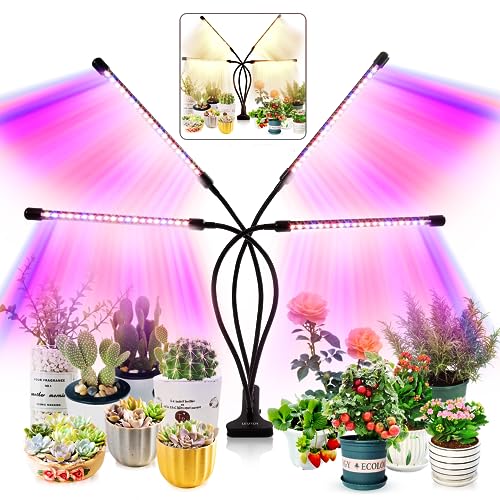
The LEOTER model combines 80 efficient LEDs in a mix of red, blue, and full-spectrum diodes, offering three spectral modes and a built-in timer. This configuration supports seed starting, rooting, and early vegetative growth by providing targeted wavelengths for photosynthesis and stem development. The timer feature, along with 10 dimmable levels, enables precise control over light duration and intensity, which can be crucial for seeds with varying germination timelines or for growers adjusting to seasonal daylight changes.
Placement flexibility comes from an adjustable gooseneck and a compact footprint, making it ideal for small desks, seedling tables, or windowsill setups. The approach emphasizes energy efficiency, while the spectrum options allow growers to tailor light to seedling readiness, reducing the risk of leggy growth or heat stress. The combination of simplicity and tunability makes LEOTER a practical choice for hobby gardeners and beginners managing limited space.
Buying Guide: Key Purchase Considerations
- Light spectrum and intensity: Seed starting benefits from full-spectrum lighting that covers a broad range of wavelengths. Look for devices with 380–780 nm coverage and a spectral mix that includes red and blue for healthy stem and leaf development.
- Coverage area and layout: For seed trays, ensure the fixture or panel size provides even coverage across the tray surface. Multi-panel systems can be useful for wider benches or multiple flats.
- Energy efficiency and heat management: LED systems typically run cooler than traditional bulbs, but higher-output options can still generate heat. Aluminum heat sinks and passive cooling help maintain consistent light output without overheating.
- Controls and scheduling: Timers (3H/9H/12H, etc.), dimming levels, and memory functions reduce maintenance and ensure consistent light cycles, which is important for germination timing and seedling vigor.
- Portability and installation ease: Plug-and-play designs, adjustable goosenecks, and linkable strips simplify setup in limited spaces or changing layouts.
When choosing a kit, consider your space, the number of seed flats, and the growth stage you’re targeting. Seed starting generally benefits from uniform, moderate-intensity light that supports germination without overheating the soil. For larger seed trays or multiple plant varieties, a modular system with expandable panels can offer better coverage and flexibility. Budget-friendly bundles provide a good entry point, while higher-end options emphasize precise spectrum control and longer lifespans for frequent use.