Modern irrigation hinges on accurate soil moisture readings. This article highlights five leading moisture sensor kits and standalone sensors ideal for DIY projects, gardens, and smart watering setups. Each option uses capacitive sensing or advanced monitoring to prevent overwatering while saving water. Explore how these tools integrate with microcontrollers or smart hubs to automate irrigation and maintain optimal soil conditions across various landscapes.
Summary of Selected Products
| Product | Brand | Type | Key Benefit |
|---|---|---|---|
| VKLSVAN 3PCS Capacitive Soil Moisture Sensor | VKLSVAN | Capacitive analog sensor | Corrosion-resistant, long life |
| AEDIKO Automatic Irrigation DIY Kit | AEDIKO | Capacitive sensor + relay kit | One-channel, ready-to-use watering |
| RAINPOINT Smart Digital Wireless Plant Moisture Meter | RAINPOINT | Wireless smart meter | Remote monitoring with app alerts |
| UMLIFE Automatic Irrigation DIY Kit | UMLIFE | Capacitive sensor with pump | Compact kit for Arduino/raspberry pi |
| AITRIP Capacitive Soil Moisture Sensor (10 Pack) | AITRIP | Capacitive sensor array | Corrosion-resistant long life |
VKLSVAN 3PCS Capacitive Soil Moisture Sensor

VKLSVAN delivers a trio of capacitive soil moisture sensors designed for 3.3–5.5V operation with a 0–3.0V output. Its corrosion-resistant design extends life in damp environments. The 3-pin gravity interface allows easy hookup to standard I/O expansion boards. Applications include DIY irrigation systems that automatically water when moisture drops below a threshold, ideal for Arduino or Raspberry Pi projects.
- Capacitive sensing avoids corrosion common to resistive sensors, enhancing durability.
- Voltage range and output suitable for microcontroller compatibility.
- 3-pack provides flexibility for multi-zone soil monitoring.
AEDIKO Upgrade Automatic Irrigation DIY Kit
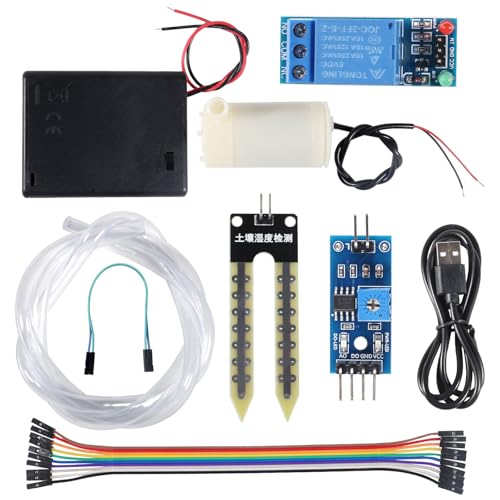
This kit combines a LM393 soil moisture detector with a 5V relay module and a small water pump, forming a ready-to-run automatic watering system. The moisture sensor operates over 3.3–5V, feeding an analog signal to trigger the relay when soil moisture falls below a set threshold. It’s suitable for garden beds, pots, or raised planters, enabling hands-off irrigation while avoiding overwatering.
- Single-channel 5V relay module supports typical garden pumps and tubing.
- Compact PCB and easy installation with fixed bolt holes.
- Versatile for Arduino, Raspberry Pi, or independent microcontroller projects.
RAINPOINT Smart Digital Wireless Plant Moisture Meter

RAINPOINT offers a wireless moisture meter with an optional Wi‑Fi hub for remote monitoring and push notifications. The device provides real-time moisture readings and supports alerting when moisture drops or rises beyond user-defined thresholds. It’s especially useful for indoor plants and outdoor gardens where monitoring via a mobile app aids in scheduling irrigation and maintaining ideal soil conditions.
- Two modes: standalone display or app-connected monitoring via a Wi‑Fi hub.
- Real-time readings with historical data for trend analysis.
- Customizable low/high moisture alerts to prevent underwatering or overwatering.
UMLIFE Automatic Irrigation DIY Kit

UMLIFE’s kit centers on a capacitive soil moisture sensor paired with a 5V relay and a compact mini pump. The capacitive sensor provides an analog moisture signal (3.3–5.5V working range) and is designed for Arduino or Raspberry Pi integration with simple wiring. The included pump delivers a controlled water flow suitable for small plantings or container gardens, delivering automation in a compact package.
- Capacitive sensor offers enhanced durability and resistance to corrosion.
- Compact pump and relay module enable a self-contained irrigation solution.
- Easy to connect to common microcontrollers for customizable control logic.
AITRIP 10 Pack Capacitive Soil Moisture Sensor
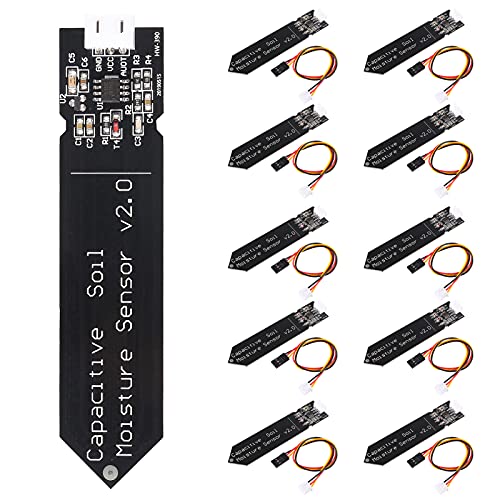
AITRIP offers a bulk pack of capacitive sensors designed for Arduino and Raspberry Pi. Each sensor uses capacitive sensing to measure soil moisture, avoiding corrosion and extending sensor life. The module includes a built-in regulator suitable for 3.3–5.5V operation, making it compatible with a wide range of hobbyist boards. It’s well-suited for multi-zone irrigation projects or educational kits.
- Capacitive sensing reduces salt and mineral interference effects.
- Built-in voltage regulator accommodates various microcontrollers.
- Ten-pack is ideal for larger or multi-zone irrigation setups.
Buying Guide: Key Considerations For Choosing Irrigation Moisture Sensors
When selecting moisture sensors for irrigation, consider the following factors to ensure reliable performance and long-term value.
-
<li Sensing method: Capacitive sensors resist corrosion better than resistive sensors, improving longevity in moist soil.
<li Voltage compatibility: Look for devices that operate within 3.3–5.5V to match common microcontrollers and single-board computers.
<li Output type: Analog outputs enable fine-grained control, while digital outputs or integrated alarms simplify simple on/off irrigation decisions.
<li Interface and wiring: Ensure connectors (PH2.0/2.54/3P) match your controller and that mounting hardware fits your setup.
<li Weather and soil conditions: For outdoor use, consider IP ratings, moisture tolerance, and the depth range of probes to suit your garden depth.
<li Network integration: Wireless options with apps or hubs enable remote monitoring and alerts, useful for unattended irrigation.
<li Expandability: Multi-sensor kits or 10-pack options help scale systems from pot plants to larger gardens.
<li Power considerations: Battery, USB, or mains-powered configurations affect how you deploy sensors in remote beds.
<li Installation ease: Kits with pre-wired pumps, relays, and fixed mounting holes reduce setup time for beginners and pros alike.
<li Data management: Apps or gateways that log moisture over time allow trend analysis and smarter watering schedules.
These considerations help tailor a system to your garden’s size, plant varieties, climate, and desired level of automation. Whether you need a simple single-zone setup or a full outdoor network of sensors, the options above provide durable sensing, straightforward integration, and scalable control for efficient irrigation.