Choosing the right freshwater water test kit helps monitor essential water parameters and protect your fish. The following five kits cover common needs, offering reliable accuracy, user-friendly results, and compatibility with hobbyist setups—from small tanks to larger community aquariums. This overview highlights what each kit tests, how results are read, and practical considerations for ongoing tank care.
| Product | Brand | Key Benefit |
|---|---|---|
| API Freshwater Master Test Kit 800-Test | API Store | Comprehensive set for five essential parameters |
| AAwipes 8-in-1 Test Kit (K02-50) | AAwipes Store | Eight parameters with quick strip testing |
| 11 in 1 Aquarium Test Strips (950 Tests) | SJ WAVE Store | Extensive parameter coverage in one kit |
| 9-in-1 Aquarium Test Strips | Aquatic Eden Store | Nine key metrics for quick checks |
| Pawfly 5 in 1 Master Test Kit | Pawfly Store | Five essential parameters with color matching |
API Freshwater Master Test Kit 800-Test

The API Freshwater Master Test Kit includes seven bottles of testing solutions, one color card, and four tubes with caps. It is designed to monitor five vital freshwater parameters: pH, high-range pH, ammonia, nitrite, and nitrate. The kit helps identify invisible water problems that can harm fish and result in losses, providing a reliable way to maintain healthy water conditions in most standard aquariums.
Users follow standard testing steps to obtain accurate readings, enabling timely adjustments to water chemistry, filtration, and maintenance schedules. The included color reference aids interpretation, and the 800-test capacity makes this kit suitable for ongoing use in busy hobby setups.
AAwipes 8-in-1 Aquarium Test Kit
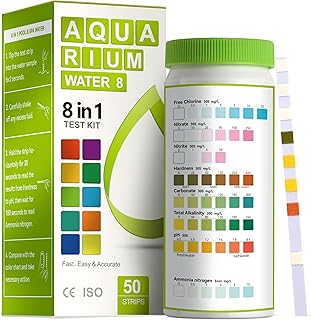
This 50-strip kit provides eight testing capabilities, including Free Chlorine, Nitrate, Nitrite, Hardness, Carbonate, Total Alkalinity, pH, and Ammonia nitrogen. It uses high-quality fibers and color-accurate pads to deliver clear results within minutes. The kit is suitable for freshwater and ponds, and it supports routine testing twice weekly to help prevent hidden water problems and keep fish healthy.
Testing steps are straightforward: dip the strip for the indicated time, briefly shake off excess water, compare to the color chart after the specified wait times, and interpret results to guide maintenance decisions. The broad parameter coverage makes it a versatile choice for hobbyists managing multiple tanks or mixed environments.
11 in 1 Aquarium Test Strips (950 Tests)

This comprehensive kit tests 11 key parameters for freshwater and saltwater tanks, including ammonia, pH, iron, chlorine, nitrate, nitrite, total hardness, carbonate hardness, total alkalinity, copper, and temperature. It is designed for at-home use, enabling a complete snapshot of water quality. The included color charts support quick interpretation, making it practical for both new hobbyists and experienced aquarists managing larger systems.
With a large test count and broad coverage, this kit supports frequent monitoring without frequent reordering. It is especially useful for tanks with sensitive species or intricate filtration setups, where precise water chemistry is critical for success and longevity of aquatic life.
9-in-1 Aquarium Test Strips

The nine-parameter test strips cover pH, nitrate, nitrite, ammonia, copper, iron, chlorine, total hardness, and carbonate hardness. Suitable for both freshwater and saltwater species, the kit supports diverse tank setups, including planted tanks and reef tanks where maintaining stable pH and nutrient levels is important. Results are read against a color chart in about a minute, offering a quick way to screen for potential water quality issues and act swiftly if readings fall outside optimal ranges.
Designed for rapid routine checks, this kit emphasizes ease of use and repeatability. It is a practical option for hobbyists who prefer strip testing over liquid reagents, especially when monitoring multiple tanks or seeking a lightweight, portable option for ongoing care and troubleshooting.
Pawfly 5 in 1 Master Test Kit

The 5-in-1 Pawfly kit monitors pH, nitrite, nitrate, ammonia, and phosphate. It uses color-matched charts to provide easy-to-interpret results, suitable for both freshwater and saltwater aquariums. The inclusion of phosphate testing helps hobbyists manage algae growth and promote stable tank conditions. The kit aims for enhanced accuracy with professional-grade liquid reagents, delivering reliable results that support consistent, healthy tank environments.
Color matching and straightforward protocols make this kit accessible for beginners, while the emphasis on core parameters supports more experienced hobbyists in targeted maintenance. The kit’s balance of simplicity and essential data makes it a dependable choice for routine checks and quick troubleshooting across a range of aquaria.
Buying Guide
- Parameter needs: Decide which parameters are most important for your tank (pH, ammonia, nitrite, nitrate, hardness, alkalinity, copper, iron, chlorine, phosphate, temperature). Kits vary in coverage, from core five to eleven or more.
- Test method: Liquid reagent kits tend to be highly accurate but require more handling, while test strips offer speed and convenience. Consider how often you test and the level of precision you require.
- Tank size and inhabitants: Larger tanks or communities with sensitive species may benefit from kits with broader parameter coverage and higher test counts, ensuring ongoing monitoring without frequent reordering.
- Ease of use: Look for clear color charts, simple dipping steps, and readable results. Some kits provide digital or more precise color matching, which can reduce interpretation errors.
- Maintenance rhythm: If you test twice weekly or more, a kit with a high test count (e.g., 800 or 950 tests) offers long-term value. For casual testing, compact kits may suffice.
- Compatibility: Some strips are suitable for both freshwater and saltwater—useful if you manage mixed or changing setups. Confirm whether the kit supports the tank’s specific needs (e.g., planted tanks, reef tanks).
- Cost of components: Over time, consider replacement reagents, color cards, and strips. A kit with readily available replacements reduces long-term costs and downtime.
- Storage and shelf life: Keep kits away from direct sunlight and heat. Check expiration dates on reagents and color cards to maintain accuracy over time.
- Guidance and troubleshooting: Choose kits that come with clear charts and recommended target ranges. Some products offer online resources or manuals to aid interpretation.