Automation in irrigation helps farmers conserve water, reduce labor, and ensure consistent moisture for crops. The following selection highlights five versatile, plug‑and‑play kits and systems designed for greenhouses, fields, and large garden setups. Each option supports programmable watering, adjustable emitters, and robust controls to fit a range of farm sizes and irrigation goals.
Summary of Selected Products
| Product | Brand | Key Benefit |
|---|---|---|
| Spider Farmer Auto Drip Irrigation System Kits | Spider Farmer | Large 13-gallon bucket, 25W pump, low water sensor for automatic stop/start |
| HEKIWAY 60FT Drip Irrigation System | HEKIWAY | Smart timer with 360° bendable hose and adjustable nozzles |
| MIXC 100Ft 1/4″ Drip System | MIXC | Universal size, bendable drip emitter rods, 360° copper nozzles |
| TJJFMM 230FT Drip System Kit | TJJFMM | Upgraded 1/2″ main line, multiple emitters, wide applicability |
| Puuku/PUUKU 240FT Drip System Kit | PUUKU | 1/2″ main line with 1/4″ distribution lines, quick-connect install |
Spider Farmer Auto Drip Irrigation System Kit

The Spider Farmer kit combines a 13-gallon reservoir with a 25W intelligent water pump, enabling up to 12 L/min flow. The built-in low water level sensor automatically stops and starts irrigation based on water availability, reducing run times and minimizing pump wear. An eight-outlet drip emitter includes a 0–360° spray range, allowing flexible watering patterns across diverse crops. The 13-gallon bucket design reduces frequent refills and offers durable, corrosion-resistant construction, aligning with ROHS standards for safer household and greenhouse use. This setup is well-suited for grow tents, greenhouses, and lawn areas adjacent to farms that need scalable, centralized irrigation control.
Key advantages include: automatic control via water level sensing, adjustable spray patterns for precise root zone delivery, and a robust reservoir designed for extended irrigation sessions. The system supports customizing irrigation schemes to fit different crop needs, from leafy greens to fruiting plants. Maintenance involves monitoring the pump and sensor to ensure consistent readings and inspecting hose connections for leaks after periods of heavy use.
HEKIWAY 60Ft Drip Irrigation System With Timer

The HEKIWAY system centers on a fully programmable smart timer for hands-free irrigation. Farmers can set precise schedules by time, frequency, and duration, and enable Rain Delay Mode (1–15 days) to pause watering during rainfall and automatically resume. A child lock helps prevent unintended changes in busy farm environments. The 360° adjustable sprayers connect to a bendable tube that can be shaped to fit irregular layouts, ensuring coverage across greenhouses, lawns, and beds. Each dripper’s flow is adjustable, enabling customized delivery to crops with differing water needs, from tomatoes to herbs.
Design considerations include timer reliability in outdoor or greenhouse environments, battery availability for remote zones, and the flexibility of the bendable tubing to accommodate curved beds or uneven terrain. While the built-in timer provides automation, farmers should plan for periodic maintenance to verify that nozzles remain aligned and that flow settings meet crop requirements during different growth stages.
MIXC 100Ft Drip Irrigation System

The MIXC kit uses universal 1/4″ fittings to align with common hoses, including 100 feet of tubing, 16 adjustable copper nozzles, and bendable emitter rods designed for flexible positioning. The aluminum interior of the rods keeps their shape and placement intact during operation. The system supports up to eight emitter rods per 50 feet of tubing, which helps farmers configure multi‑zone layouts across raised beds, greenhouses, or outdoor plots. Copper nozzles enable durable, long-lasting watering patterns that can be tailored from mist to a steady stream, accommodating a variety of crops and soil types.
Practical considerations include ensuring compatibility with existing irrigation zones and confirming that the main tubing can handle the desired pressure. While DIY installation is straightforward, correct spacing of emitters and avoiding excessive length on individual runs are important to prevent uneven moisture distribution. Regular check-ins to replace worn nozzles and clean emitters will preserve system efficiency over growing seasons.
TJJFMM 230FT Drip System Kit

The TJJFMM kit features an upgraded 1/2″ main tube designed to handle higher water pressure and includes a 1/2″ tee connector for easy division into multiple irrigation subsystems. Its kit design supports 2 drip systems or a single extended layout to irrigate lawns, greenhouses, or raised beds efficiently. Quick-connect components streamline installation and minimize the need for tools or special skills. A 4‑way connector and emitters attach directly to 1/4″ tubing, enabling rapid setup and reliable, drip-based irrigation that minimizes surface runoff and evaporation.
Farmers should evaluate the layout of fields and greenhouses to determine whether to run two separate zones or one long loop. The flexibility of the quick-connect design reduces setup time, but ongoing care should focus on ensuring tight connections and protecting exposed tubing from temperature extremes or solar wear. Regularly calibrating emitters to match crop water requirements will help maximize water efficiency and crop yield.
Maotong 240FT Drip Irrigation System Kit
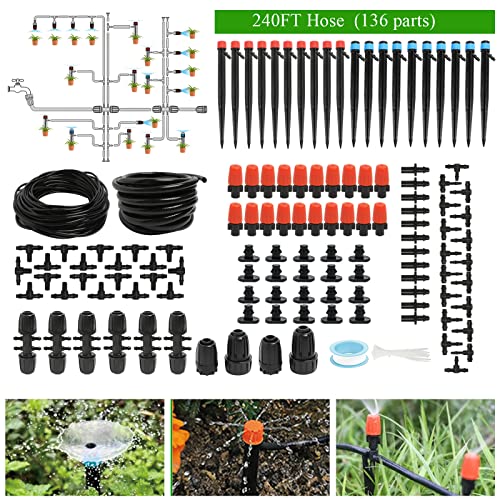
The Maotong kit provides 240 feet of drip infrastructure, including a 40-foot main tubing segment (1/2″) and 200 feet of distribution tubing (1/4″), with 136 parts to build two smaller systems or a single extended layout. The upgraded 1/2″ main line supports higher water pressure, enabling stable delivery across larger areas. The kit emphasizes significant water savings—up to 80% compared with traditional irrigation methods—by directing water directly to root zones. This makes it suitable for yards, greenhouses, and farms with diverse crop needs and limited water resources.
Best-use considerations include planning for modular expansion or splitting into two zones for crop rotation or different soil types. Regular inspection of main line integrity and connector seals is essential to prevent leaks that waste water. The broad part count gives flexibility for future reconfigurations as farm layouts evolve.
PUUKU 240FT Drip System Kit

The PUUKU kit combines 1/2″ main tubing with 1/4″ distribution lines and a 6-way connector for versatile layouts. The quick-connect design is push-to-connect, requiring no heating or special tools—just snap the tubes and emitters into place. This DIY-friendly kit supports a broad range of applications, including greenhouses, raised beds, lawns, and outdoor gardens. With 240 feet of tubing, it accommodates large plots and complex irrigation patterns, delivering targeted moisture to root zones while minimizing waste.
Considerations for PUUKU include ensuring all connections stay secure under outdoor conditions and selecting appropriate emitter types for different plant densities. The quick-connect approach is ideal for rapid deployment and field adjustments, but farmers should routinely inspect for wear at connection points and replace worn fittings promptly to maintain efficiency.
Buying Guide: Key Purchase Considerations
- Scale and layout: Choose a system that matches field size, greenhouse coverage, and bed dimensions. Look for modular kits that can be expanded into multiple zones as farm needs change.
- Water source and pressure: Higher‑quality kits tolerate variations in water pressure. If your water source is inconsistent, prioritize systems with pressure-compensating emitters or main lines designed for robust flow.
- Control and automation: Timers, sensors, and app control improve efficiency. Consider whether you need simple schedule-based watering or advanced smart controls that factor weather and soil moisture.
- Emitters and spacing: Adjustable nozzles and bendable lines allow precise root-zone irrigation. Plan emitter density based on crop type, soil texture, and root depth.
- Installation and maintenance: Quick-connect designs speed setup, but ensure compatibility with existing tubing. Regular checks for leaks, clogged emitters, and sensor accuracy minimize downtime.
- Durability: Outdoor systems should withstand sun exposure and temperature changes. Look for corrosion-resistant materials and robust reservoir options where applicable.
- Cost of ownership: Consider initial kit price, components needed for expansion, and potential replacement parts. Long-term water savings can offset upfront costs.
- Support and documentation: Clear installation guides and accessible customer support help ensure successful deployment, especially for farm-scale projects.
In practice, farmers may combine several systems to address different crops or microclimates within a single operation. For example, a greenhouse might use a smart-timer setup for seedlings and a larger, uncovered area could employ modular drip lines with flexible emitter rods. The ideal choice balances automation, water efficiency, ease of maintenance, and adaptability to future crop planning.